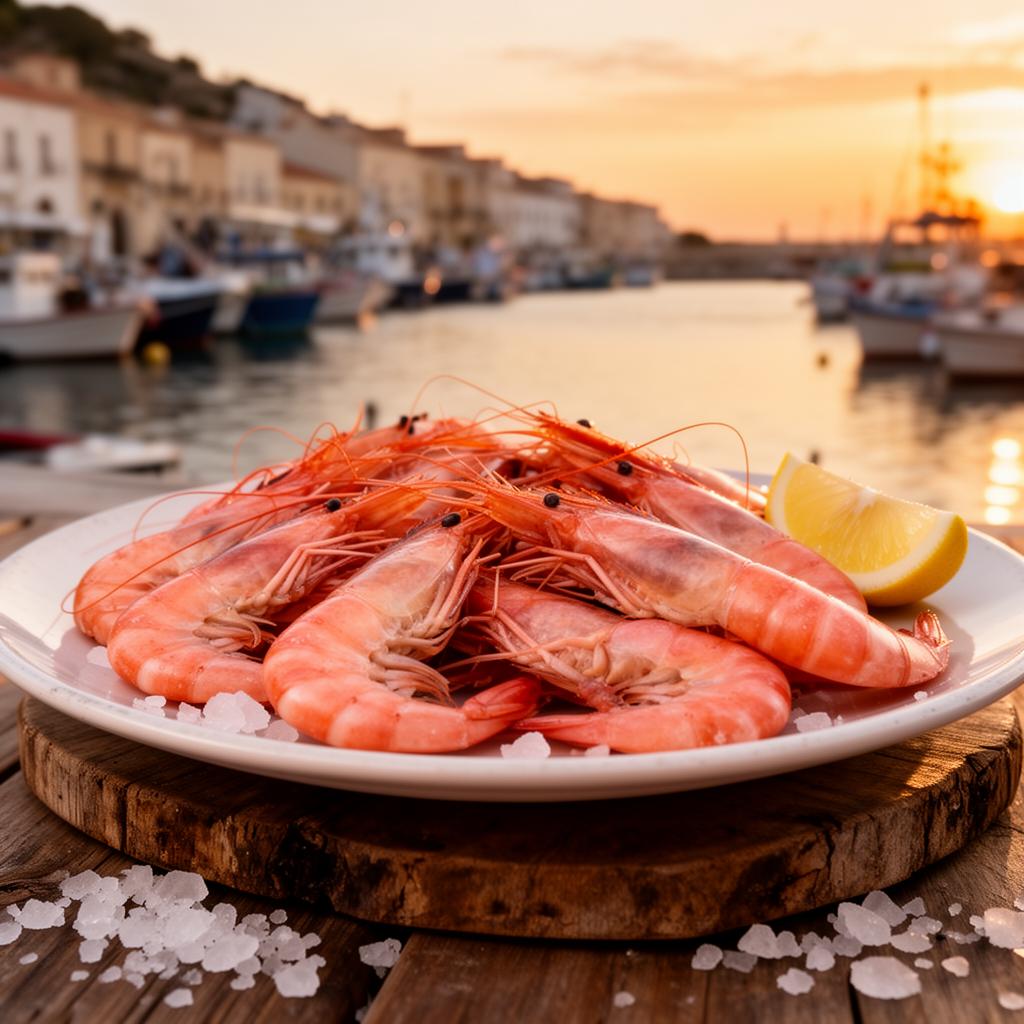
[IMAGE: Plate of freshly cooked Motril shrimp on a rustic wooden board, with sea salt flakes, a lemon slice, and a blurred background of Motril fishing port at sunset
Golden light illuminates the intense pink color of the shrimp
ALT: "Plate of cooked Motril shrimp ready to eat, served with lemon and sea salt."] There are flavors that are capable of capturing the essence of a place
Aromas that instantly transport us to a fish market at sunset, to the sound of waves breaking on the shore, to the feel of salt on the skin
The Motril shrimp is, without a doubt, one of those flavors
This small crustacean with a translucent body and almost unreal cobalt blue roe has earned its title as a gastronomic jewel of the Mediterranean, a treasure that transcends the culinary to become the soul and pride of the Costa Tropical of Granada
Fished in the abysses of the enigmatic Alboran Sea , auctioned every afternoon in a frantic dance of prices and bids at the Motril fish market , and revered in the kitchens of the country's most prestigious chefs, the shrimp is much more than a simple seafood
It is the livelihood of entire families of fishermen, the economic engine of a historic port, and the reason why gourmets from all over the world set their sights on this corner of southern Spain
It is Motril's "darling," and in every bite, you can taste the respect for the sea, tradition, and the tireless pursuit of excellence
In this definitive guide, the most complete you will find, we are going to reveal each and every one of its secrets
From its scientific name to the legends circulating in the fish market, from the mysterious underwater mountains where it lives to the infallible trick to know if it is fresh
We will teach you how to cook it like an authentic Motril native, we will tell you where to eat it when you visit us in [INTERNAL LINK: our apartments in Playa Granada → /apartamentos-playa-granada/] and we will explain why its price can exceed that of the most exclusive meats
Get ready for a journey into the depths of flavor
The queen of the sea is waiting for you
What exactly is Motril shrimp? When we talk about Motril shrimp , we are not referring to just any shrimp
We are talking about a specific species, with a unique DNA and organoleptic characteristics that make it unmistakable
Let's delve into its biological ID to understand why it is so special
Scientific name and taxonomic classification Under its popular name hides the Plesionika narval (Fabricius, 1787) , a fascinating crustacean belonging to the class Malacostraca, the order Decapoda (ten legs) and the family Pandalidae
It is important to note that, in some older scientific studies, it can be found referenced as Plesionika edwardsii (Brandt, 1851), due to a taxonomic debate that is largely resolved today in favor of the first denomination
It is, in essence, a type of deep-water shrimp
The word "quisquilla" itself comes from the vulgar Latin quisquilia , which meant "trifle" or "small thing." A name that, while describing its size, does not do justice to the enormity of its flavor
And although this is its official name, on the docks of the [INTERNAL LINK: Costa Tropical → /costa-tropical/] you will hear it called by more affectionate and descriptive names: fishermen call it "periquito" (parakeet), while in other areas it is known as "camarón soldado" (soldier shrimp) or, very graphically, "camarón de barriga azul" (blue-bellied shrimp), in honor of its most distinctive and valuable feature: the intensely cobalt blue roe carried by the females
Shrimp vs. prawn vs. common shrimp: real differences In the world of seafood, terminology can be confusing
Many use "quisquilla," "gamba," and "camarón" almost as synonyms, but biologically and gastronomically, the differences are vast
Let's clarify concepts so you never get fooled again. [IMAGE: Comparative infographic to scale showing a Motril shrimp (with its blue roe and long antennae), a white prawn (larger and paler) and a common shrimp (smaller and banded)
Each with its scientific name
ALT: "Comparative infographic of the visual differences between Motril shrimp, white prawn and common shrimp."] Characteristic Motril Shrimp ( Plesionika narval ) White Prawn ( Parapenaeus longirostris ) Common Shrimp ( Palaemon serratus ) Taxonomy Infraorder Caridea (true shrimp) Suborder Dendrobranchiata (prawn) Infraorder Caridea (true shrimp) Size From 8 to 17 cm
Commercial specimens 5-12 cm
Larger, from 12 to 16 cm
Smaller, maximum 8 cm